
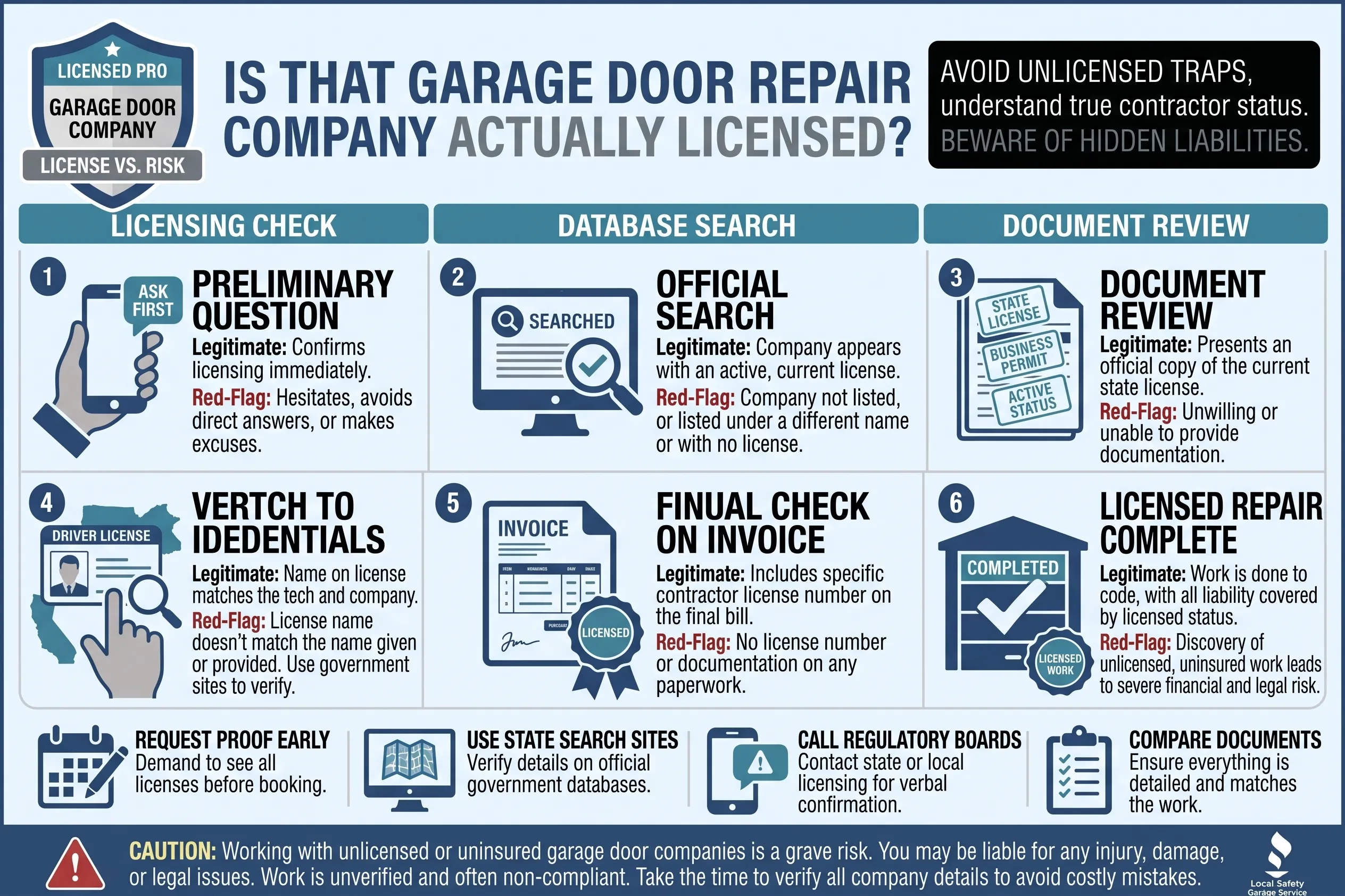
You can verify whether a garage door repair company is actually licensed by asking for their license number directly, checking it against your state’s licensing or consumer protection website, confirming general liability insurance, and looking for a real, verifiable business address rather than just a phone number. Garage door work is only lightly regulated in many states, which is exactly why scam operators rely on homeowners not checking at all, no matter which of our areas we serve you happen to live in.

What to Check | Licensed Company | Unverifiable Operator |
License number | Provided readily, checks out with the state | Vague, refused, or claims “not required” |
Insurance | Certificate available on request | No proof offered, or ignored when asked |
Business address | Real, verifiable, matches listings | Inconsistent, residential, or missing entirely |
Vehicle | Branded, matches company name | Unmarked or mismatched name |
Reviews | Specific, consistent across platforms | Sparse, generic, or recently mass-posted |
Phone number | Matches the business consistently | Different number than what’s listed online |
Before scheduling anything, ask the company for their license number. In states that require licensing, a legitimate company will have this ready, since it’s information they provide routinely to every new customer who asks and often list openly on their own website and invoices.
Licensing requirements vary widely. Some states license garage door companies specifically, others fold this work into a general contractor license once the job crosses a certain dollar threshold, and a handful of states have no licensing requirement at all for this trade. That inconsistency is exactly what scam operators count on: they’re betting you don’t know your own state’s rules well enough to push back when they dodge the question.
Take the license number and check it against your state’s licensing board or consumer protection website yourself, rather than trusting a number read off over the phone. Many states have a free online lookup tool for exactly this purpose, and it typically takes less than a minute to confirm whether a license is active, expired, or doesn’t exist at all. If the number doesn’t match the business name given, or doesn’t come up at all, that’s a direct answer, not a gray area.
Phrasing the question naturally helps too. Something as simple as “What’s your license number, so I can note it down for our records?” signals that you expect this to be normal, and a legitimate company will treat it as a routine part of scheduling rather than an unusual demand.
Insurance matters because if something is damaged during the repair, your garage door track, the wall, your vehicle parked inside, an uninsured company leaves you covering the cost yourself, even if the damage was clearly their fault. Homeowners insurance typically doesn’t cover damage caused by a contractor’s mistake.
Ask for proof of general liability insurance before work begins, and don’t accept a verbal assurance. A legitimate company can provide a certificate of insurance on request, usually a one-page document from their insurer listing coverage amounts and an expiration date. If a technician says “don’t worry about it, we’ve never had an issue,” treat that as a non-answer rather than reassurance, since it tells you nothing about whether coverage actually exists.
It’s also worth asking whether the technician is covered by workers’ compensation insurance, separate from general liability. If an uninsured technician is injured on your property, for instance, falling while working near the top of the door track, you could be the one exposed to that liability rather than the company that sent them.
If the same visit also comes with a push toward full spring replacement, that combination is worth a closer look. Read Do I Really Need New Garage Door Springs Right Now? 5 Signs a Repair Is an Unnecessary Upsell to see whether the recommendation holds up.
Scam operations frequently operate out of a call center with no physical location, or list an address that turns out to be a residential property, an empty lot, or an unrelated business. This matters because a real address means there’s a place to hold the company accountable if something goes wrong; a fake one means the operation can disappear the moment there’s a complaint.
Search the address the company gives you on Google Maps and cross-check it against their website and online listings. Inconsistent addresses across directories, an address that doesn’t match street view, or no address at all, is a strong signal to keep looking rather than a minor inconsistency to overlook. It only takes a couple of minutes, and it’s one of the hardest things for a scam operation to fake convincingly.
If you’re trying to understand how a company can get away with any of this in the first place, read How Does the Emergency Garage Door Repair Scam Work for the complete picture of the tactics involved.
Legitimate companies tend to show up consistently: a branded vehicle, a matching business name across Google, the Better Business Bureau, and their own website, and reviews that reference specific, plausible details, a technician’s name, a particular repair, a reasonable timeline. Scam operations tend to fall apart under this scrutiny because maintaining a consistent, verifiable presence across multiple platforms takes real infrastructure that a fly-by-night operation usually hasn’t built and often has little incentive to build.
If a company already dodged your pricing questions earlier in the call, that pattern tends to continue here too. Read Why Is My Emergency Garage Door Repair Quote So Much Higher Once They Arrive? 5 Bait-and-Switch Pricing Tricks to see how the two issues typically show up together.
The International Door Association flagged this exact combination on LinkedIn as an industry-wide pattern.
Ask for the technician’s name and the company name before they get out of the vehicle, and confirm both match what you were told on the phone. An unmarked vehicle with no visible company branding is a legitimate reason to pause before letting anyone in, and it’s reasonable to ask directly why there’s no signage if the company claims to be an established local business. A technician with nothing to hide won’t be offended by the question.
Some operators go a step further and impersonate an actual, well-reviewed local company, using a similar name, a copied logo, or photos lifted from the real business’s website. If anything about the name or branding feels slightly off from what you researched online, call the real company’s listed number directly to confirm the appointment before letting the technician start any work.

Checking a license, insurance, and business address takes a few minutes on the phone or a quick search before anyone arrives, and it closes off one of the most common paths scam operators rely on: homeowners assuming that if a company answers the phone and shows up in a search result, it must be legitimate. None of these checks require any technical knowledge about garage doors themselves, just a willingness to ask a few direct questions and verify the answers independently rather than taking them at face value.
Flush Mount Door Co. is upfront about licensing, insurance, and who’s actually coming to your home, so you never have to guess who you’re letting into your garage. Contact us or give us a call before you decide who to trust with the job.