
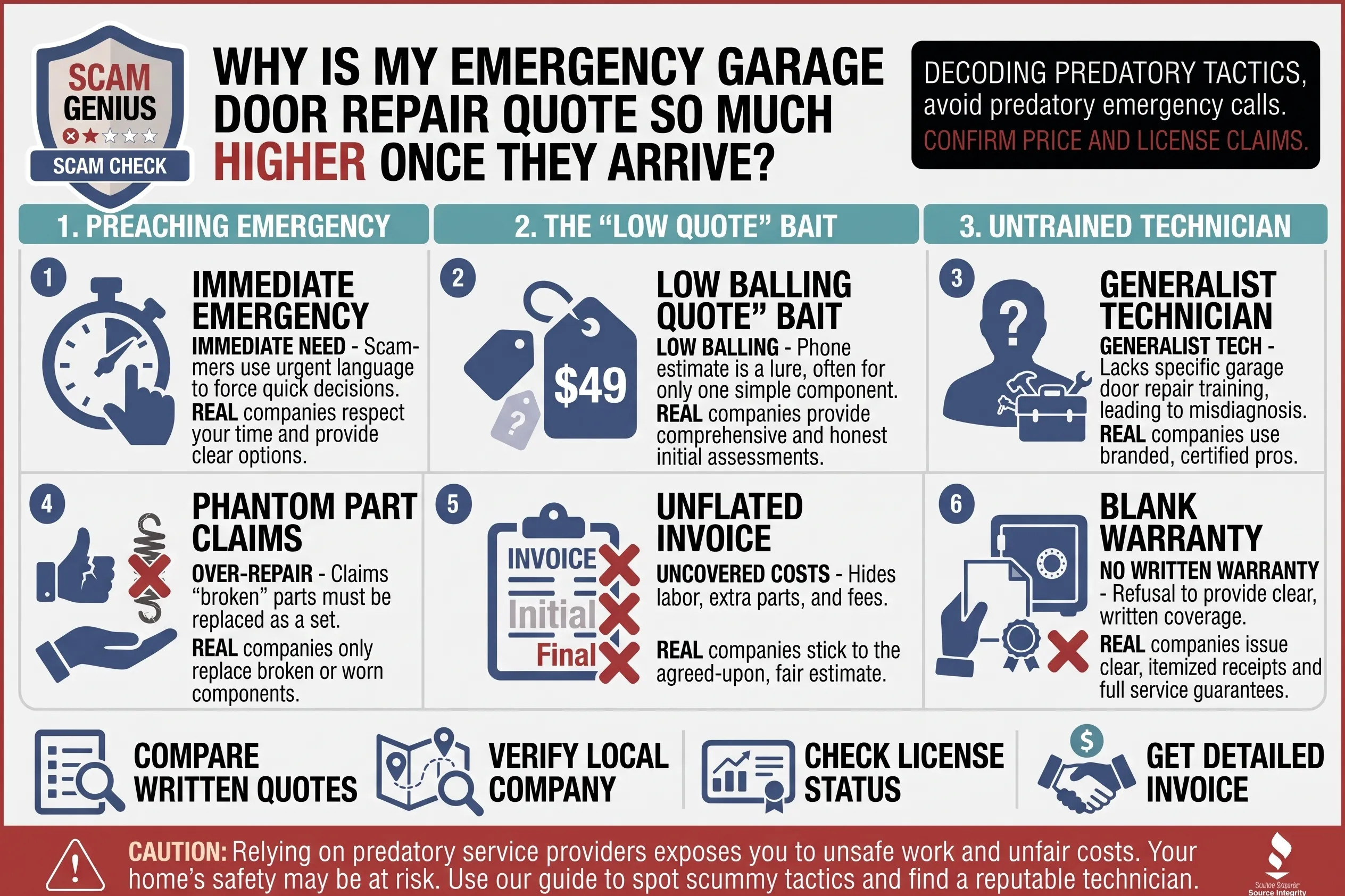
Your emergency garage door repair quote goes up once the technician arrives because the advertised price was never meant to reflect the real job; it was designed to get a technician inside your garage. From there, five common tricks (added diagnostic fees, “the part is worse than we thought,” labor charged separately, replacing instead of repairing, and pressure to decide on the spot) turn a $49 advertised call into a bill that’s several times higher. Recognizing each tactic in the moment is usually enough to stop it from working, whether you’re in one of our areas we serve or anywhere else.

What’s Advertised | What Often Happens |
“$49 service call” | Diagnostic fee, parts, and labor added separately, no total until they’re inside |
“Free inspection” | Inspection used to justify an urgent, inflated repair recommendation |
“Same-day repair” | Urgency used to prevent comparison shopping |
Verbal quote only | No written total until after work begins |
“It’s worse than we thought” | No specific defect shown to support the higher price |
The advertised price ($49, $59, “free inspection”) almost always covers just the technician showing up and diagnosing the problem, not the actual repair. Most homeowners don’t realize this until the technician quotes a second, much larger number for parts and labor. The ad itself is technically accurate, it just leaves out the part that matters most, and that omission does all the work.
Ask directly on the phone: “Does that price include parts and labor, or just the visit?” A legitimate company will answer plainly; a scam operator will often dodge the question or say “we’ll know once we’re there.” If you get a vague answer, ask the follow-up question again in a different way before agreeing to the appointment, since a second dodge is a much clearer signal than the first, and it costs you nothing but a few extra seconds spent on the phone.
Some operators add a separate “diagnostic fee” on top of the advertised price once they’ve already opened up your garage door system, essentially charging you to find out what the real price will be. This fee is rarely mentioned on the initial call, and by the time it comes up, the door is already partially disassembled, which makes walking away feel a lot less appealing than it would have an hour earlier.
If a company is willing to hide a fee like this, it’s also worth asking whether they’re even a properly licensed operation. Read Is That Garage Door Repair Company Actually Licensed? 4 Ways to Verify Before They Touch Your Door to see what a legitimate business should be able to show you before they touch your door.
Ask specifically whether there’s a diagnostic or inspection fee separate from the advertised price, and get the answer in writing (a text or email confirmation is enough) before you agree to the appointment. If a fee does apply, ask what it covers and whether it’s credited toward the repair cost if you decide to proceed, since some legitimate companies do this, and it’s a reasonable, disclosed practice; the problem is only when it shows up as a surprise.
This is the most common escalation line: the technician claims the original issue is more serious than described, the springs are “shot,” the opener “can’t be saved,” and so on, usually with no clear evidence shown. It’s designed to justify a bigger number without giving you anything concrete to question, and it works particularly well because most homeowners have no independent way to judge whether a spring is genuinely failing or just old.
The International Door Association called out this exact tactic in a LinkedIn post aimed at homeowners, a sign the pattern shows up across regions rather than being tied to one bad actor.
Ask the technician to physically show you the failed part, a stretched spring, a frayed cable, before agreeing to the higher price. If they can’t point to something specific, pause the job and get a second technician to look at it. A photo of the part in question, taken on your own phone before any repair begins, also gives you something concrete to show a second company if you decide to get another opinion.
Many components (springs, cables, sensors, individual panels) can often be repaired for a fraction of the cost of full replacement. Scam operators frequently skip straight to “the whole thing needs to be replaced” because a full-system job pays significantly more than a targeted repair, and a homeowner under pressure rarely stops to ask whether a smaller, cheaper fix was ever actually on the table.
If springs specifically are the part being pushed toward full replacement, read Do I Really Need New Garage Door Springs Right Now? 5 Signs a Repair Is an Unnecessary Upsell for a full breakdown of this specific tactic.
Ask whether a repair is possible before agreeing to a replacement, and ask what specifically makes a repair not viable. A legitimate technician can explain this in plain terms, pointing to the exact part and the exact reason it can’t simply be fixed; a scam operator usually can’t, or won’t, and tends to fall back on general statements about age or wear instead.
The final trick isn’t a separate fee; it’s tempo. By keeping the visit fast-moving and implying the price or availability won’t hold if you wait, the technician removes your ability to call a second company for comparison. This works because most people don’t like the awkwardness of pausing a conversation to make a phone call in front of someone who’s standing right there waiting on an answer.
If you want to see this entire pattern laid out from start to finish, read How Does the Emergency Garage Door Repair Scam Work for the complete picture, including the licensing and spring-replacement angles too.
Tell the technician you need ten minutes to make a call, and pay attention to how they react. A legitimate company will wait; a scam operator will often push back hard, bring up a supposed limited-time discount, or claim they have another job to get to, which is itself a signal. It’s reasonable to view any resistance to a short pause as more informative than anything printed on the invoice.

A bait-and-switch garage door quote relies on you not asking the right question before the technician arrives, and not slowing down once they’re already in your garage. Asking what the advertised price actually covers, and requesting a written quote before any work starts, closes most of the gap scammers rely on. None of these questions require any technical knowledge, just a willingness to ask them out loud before a technician is standing in your driveway.
If you’re tired of guessing what a repair will actually cost, Flush Mount Door Co. provides transparent, written quotes before any work begins, so you always know the full price before a technician ever sets foot in your garage. Contact us or give us a call to get a straightforward, no-pressure quote.