
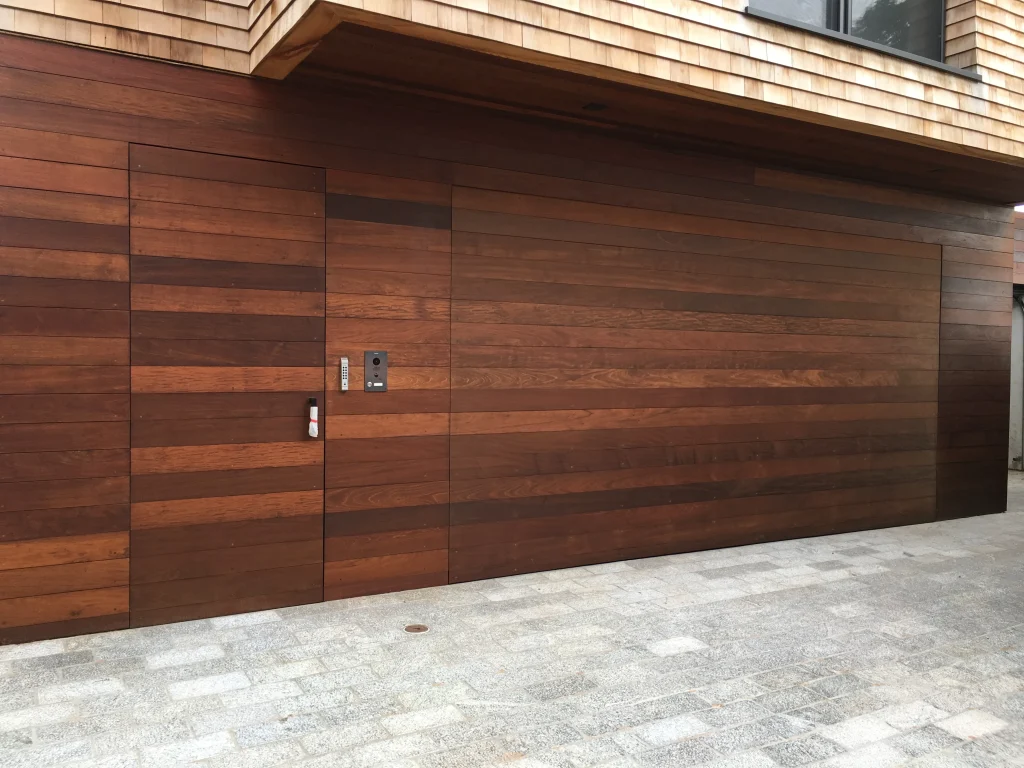
Wood Flush Mount Garage Doors insulate moderately on their own, better than bare aluminum, but not as well as foam-core insulated steel or composite. Wood’s natural R-value typically falls in the 2 to 6 range depending on species and thickness, and it only reaches the 12+ range that foam-core materials hit once an insulated backer is added behind the wood face. For homeowners who want the wood look without sacrificing performance, that backer decision is the single most important choice to get right upfront. Browsing photos of Flush Mount Doors with wood facing can help you see how different species and finishes look before deciding on the backer construction behind them.
Read Which Flush Mount Garage Door Material Insulates Best? 6 Options Ranked by R-Value for how wood stacks up against all six Flush Mount options, not just insulation.

Wood Configuration | Typical R-Value | Best For |
Solid slab, no backer | 2 to 4 | Mild climates, appearance-first buyers |
Solid slab with rigid foam backer | 6 to 10 | Moderate climates wanting the wood look |
Engineered/veneered core with foam layer | 8 to 14 | Colder climates wanting wood appearance closer to foam-core performance |
Foam-core steel or composite (for comparison) | 12 to 20+ | Cold climates or attached garages prioritizing insulation first |
On its own, solid wood typically lands in the R-2 to R-6 range, depending on species and thickness. That’s meaningfully better than bare aluminum, but well short of the R-12 to R-20+ range that foam-core insulated steel and composite doors reach. Wood is a naturally poor conductor of heat compared to metal, which is why it feels warmer to the touch, but “feels warmer” and “insulates as well as a foam core” are different things. This is one of the more common misconceptions homeowners bring to a quote call, and it’s worth clearing up before you commit to a specific configuration.
Ask for the manufacturer’s stated R-value for the specific wood species, thickness, and construction, rather than assuming a wood door insulates as well as steel just because it feels warm to the touch.
A solid slab wood door and an engineered or veneered wood door can perform very differently. Engineered cores can be built with a foam or composite layer sandwiched inside, closing much of the gap with foam-core steel, while a true solid wood slab has no room for that added layer without changing the panel’s construction entirely. From a distance, the two can look nearly identical. Hence, the difference is entirely in the build, not the visible finish, which makes it easy to overlook if you’re only comparing photos rather than specs.
Since a solid slab has no internal cavity for foam, the practical fix is adding a rigid foam backer to the interior face rather than trying to modify the slab itself.
Composite with a wood-look finish is a common alternative for buyers who want higher R-value without adding a backer to real wood; read Do Composite Flush Mount Garage Doors Insulate as Well as Wood or Steel? 5 Things to Know for the full comparison.
A rigid foam board or spray-foam layer fitted behind the wood face is what actually closes most of the gap with foam-core steel or composite. This is the single biggest factor in wood door insulation performance, bigger than species or thickness. Homeowners who skip this step and expect foam-core-level results from wood alone are usually the ones surprised by their garage’s temperature swings later.
Have the foam-core backer built in at the time of custom fabrication if possible, since retrofitting an even, well-sealed foam layer after installation is harder to get right than building it in from the start.
Denser hardwoods like oak generally insulate slightly better than softer woods like pine, and thicker panels insulate better than thin ones. That said, this difference is small compared to the jump you get from adding a foam backer; species and thickness are secondary factors, not the main lever. Homeowners sometimes assume that upgrading to a denser hardwood alone will solve an insulation problem, but the improvement is usually modest compared to what a backer delivers.
For a broader overview of how garage doors are built and specified across materials, This Old House’s guide on all about garage doors is a useful general reference alongside the wood-specific factors here.
Yes, but modestly. Going from a thin to a thick solid wood panel typically moves the R-value by a point or two, far less than the jump from adding an insulated backer.
In very cold climates, or garages directly beneath living space, solid wood without a backer usually isn’t enough on its own to match the comfort and energy performance of foam-core steel or composite. Wood remains a reasonable choice in these climates, but it typically needs the added backer to perform at a similar level. Skipping the backer in a harsh climate is one of the more common regrets we hear about after the fact, since it’s much easier and more cost-effective to specify a backer upfront than to retrofit one evenly after the door is already installed.
If you want the wood look but need foam-core level performance and don’t want to add a backer, foam-core insulated steel or composite with a wood-look finish is usually the better-performing alternative. Both can be finished to closely resemble real wood grain, so you don’t have to sacrifice much visually to gain the insulation benefit.
Wood also has its own maintenance needs tied to insulation performance over time. DASMA’s safety tips for garage door owners cover general upkeep considerations worth keeping in mind alongside material-specific care.
If foam-core level performance is the top priority and you’re flexible on the exact look, read our Steel vs. Aluminum Flush Mount Garage Doors: 7 Differences That Matter.

If you love the look of wood and insulation matters for your climate or garage setup, plan on an insulated backer or an engineered core from the start rather than adding it later.
Flush Mount Door Co. builds wood Flush Mount Doors with insulated backers specified up front when climate calls for it. Contact us or give us a call to request a free quote, and we’ll talk through the right wood configuration for your home, including species, thickness, and backer options that fit your climate, budget, and desired look.