
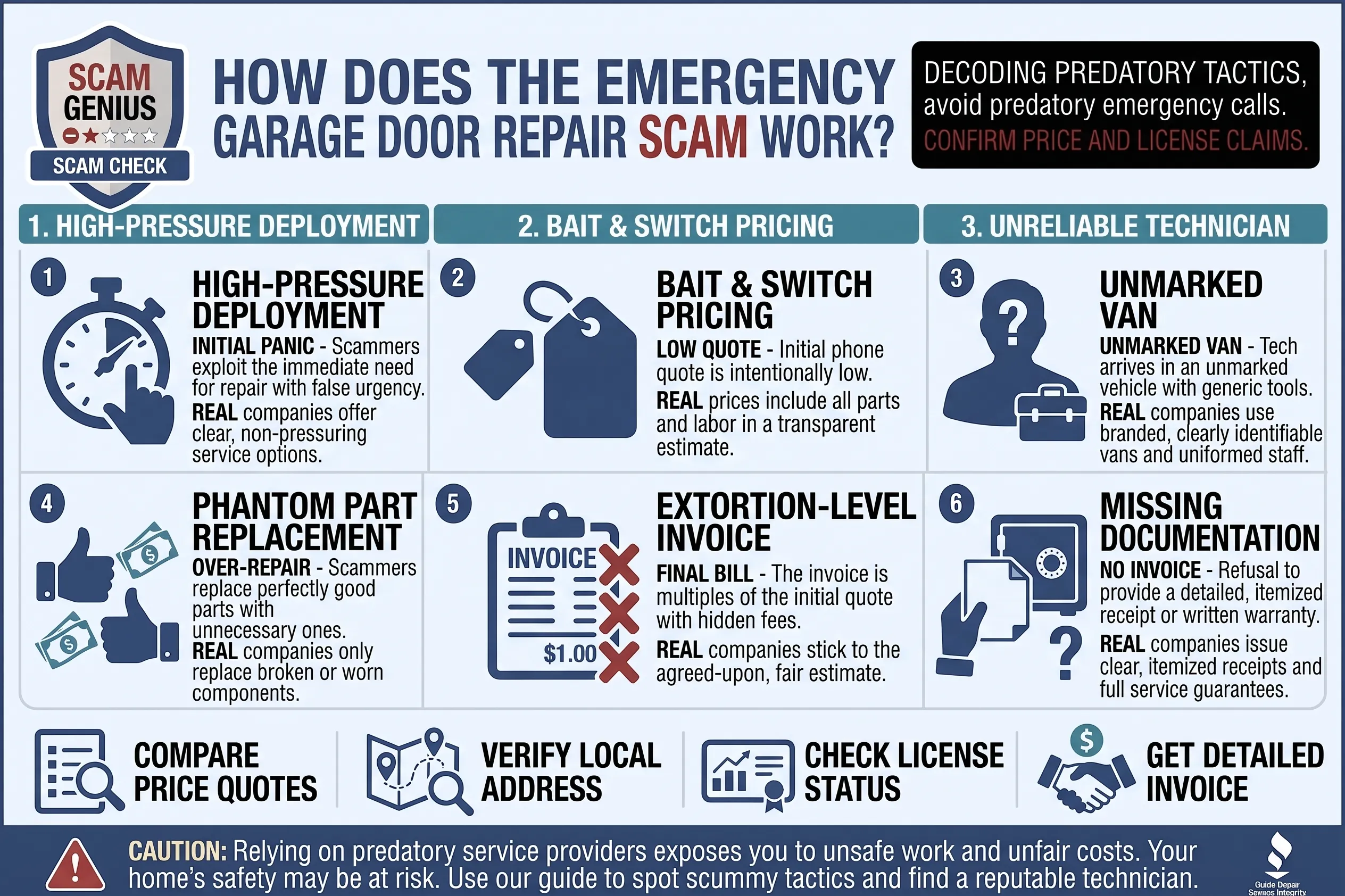
The emergency garage door repair scam works by luring homeowners in with an unrealistically low advertised price, then using high-pressure, in-the-moment tactics (fake safety threats, cash-only demands, and unnecessary parts replacement) to inflate the bill once a technician is already inside your garage. The scam relies on urgency: a door that won’t open feels like an emergency, and that panic is what stops people from questioning the quote, checking a license, or calling a second company for comparison. This pattern shows up nationwide, including throughout our areas we serve.

What to Check | Legitimate Company | Scam Warning Sign |
Quote | Written estimate before work starts, covers parts + labor | Verbal-only, changes once technician arrives |
Licensing | Provides license/insurance info without hesitation | Vague, evasive, or claims none is needed |
Urgency | Gives an honest answer if it’s safe to wait | Insists everything is an emergency |
Diagnosis | Shows you the specific failed part | Recommends full replacement with no clear defect shown |
Payment | Accepts cards, provides itemized invoice | Cash-only, vague total, no breakdown |
Warranty | Written warranty on parts and labor | No warranty offered or mentioned |
The scam almost always starts with an advertised price that’s far below market rate, a $49 service call, a “free inspection,” or a flat “$89 spring repair.” That number wins the phone call, not the actual job.
Once the technician is in your garage, the quote changes. Suddenly there’s a “diagnostic fee,” the original part is “worse than expected,” or the advertised price only covered a service call, not labor or parts. By the time the new number appears, the homeowner has already taken time off, let the technician in, and often has a garage door partially disassembled, three forces that make it much harder to say no.
Get the full quote in writing, including parts and labor, before the technician starts any work, and treat any refusal to provide that as a hard stop. A legitimate company can give you a real price range over the phone based on the symptom you describe; if a company won’t commit to anything beyond “we’ll know when we get there,” that’s a signal to keep calling around.
If you want to see each version of this pricing trick in more detail, read Why Is My Emergency Garage Door Repair Quote So Much Higher Once They Arrive? 5 Bait-and-Switch Pricing Tricks.
Scammers disproportionately target calls that come in at night, on weekends, or during a “my door won’t close and I need to leave for work” panic. Urgency is the entire business model: it shortens the time a homeowner spends comparing prices, checking reviews, or verifying a license.
Some operators go further and create urgency that doesn’t exist, telling you the door is at risk of falling, or that a cable “could snap at any moment,” when the actual issue is minor. The goal is to get a signature before you have time to think.
If the door isn’t actively blocking a vehicle or posing an immediate safety hazard, it can typically wait a few hours for you to get a second quote. Ask directly: “Is this safe to leave until tomorrow?” A legitimate technician will give you a straight answer; a scam operator will almost always say no, regardless of the actual condition.
This is one of the most common and most profitable tactics: telling a homeowner their torsion springs, cables, or entire opener assembly need full replacement, when the actual issue is a simple adjustment, lubrication, or a single worn part.
Springs and cables are also chosen deliberately because they’re genuinely dangerous for an untrained homeowner to inspect or touch, which makes most people take the technician’s word for it rather than looking closely themselves.
Ask the technician to show you the specific point of failure, a visibly stretched or rusted spring, a frayed cable, and ask whether a repair (rather than full replacement) is possible. If they can’t or won’t point to a concrete defect, or immediately jump to “the whole system needs replacing,” get a second opinion before authorizing the work.
If you want the full breakdown of this specific tactic, read Do I Really Need New Garage Door Springs Right Now? 5 Signs a Repair Is an Unnecessary Upsell.
Many scam operations aren’t a company at all; they’re a call center that dispatches whoever is available, with no license, no insurance, and no accountability if something goes wrong. Because garage door companies are lightly regulated in a lot of states, homeowners rarely ask for a license number the way they would for an electrician or plumber.
Ask for the company’s license number (where the state requires one) and general liability insurance before scheduling, and independently verify it rather than taking their word for it. A company that hesitates, gets vague, or claims “we don’t need one for this kind of work” should be treated as a red flag, not reassurance.
If you want a complete verification checklist, read Is That Garage Door Repair Company Actually Licensed? 4 Ways to Verify Before They Touch Your Door.
Legitimate companies accept credit cards and provide itemized invoices, because both create a paper trail. Scam operators frequently insist on cash, a check to an individual rather than a company, or a wire transfer, specifically because those methods are difficult or impossible to reverse once you realize you were overcharged.
Pay by credit card whenever possible and insist on an itemized, company-letterhead invoice, not a handwritten receipt. If a technician pushes hard for cash or refuses to itemize, that alone is reason enough to stop the job and dispute the charge if payment has already been made.
The final tell is what happens after the job: a legitimate repair comes with a written invoice breaking down parts and labor, and some form of warranty. Scam operators tend to hand over a vague total with no breakdown and no warranty, because an itemized invoice would make the overcharge obvious, and a warranty is a commitment they never intend to honor.
Request an itemized invoice and written warranty terms before final payment, not after. If you’ve already paid and were given neither, that’s grounds to dispute the charge with your card issuer and to report the company to your state’s consumer protection office or licensing board.
This pattern is common enough that the International Door Association (IDA) now maintains a dedicated scam-awareness resource for homeowners, including guidance on reporting fraudulent businesses and finding credentialed professionals. The IDA has also flagged this scam pattern industry-wide on its own channels, underscoring that this isn’t an isolated or regional problem.

The emergency garage door repair scam works because it turns a stressful, time-sensitive situation into an opportunity to skip the steps homeowners would normally take: checking a license, getting a second quote, reading the invoice closely. Slowing down at each of those steps is what breaks the scam.
If you’re weighing whether to keep patching an aging door versus replacing it altogether, it’s worth talking to a team that’s upfront about pricing and process from the first call. Flush Mount Door Co. walks every customer through a transparent, itemized quote before any work begins, so you know exactly what you’re paying for and why. Contact us or give us a call to get a straightforward, no-pressure quote.