
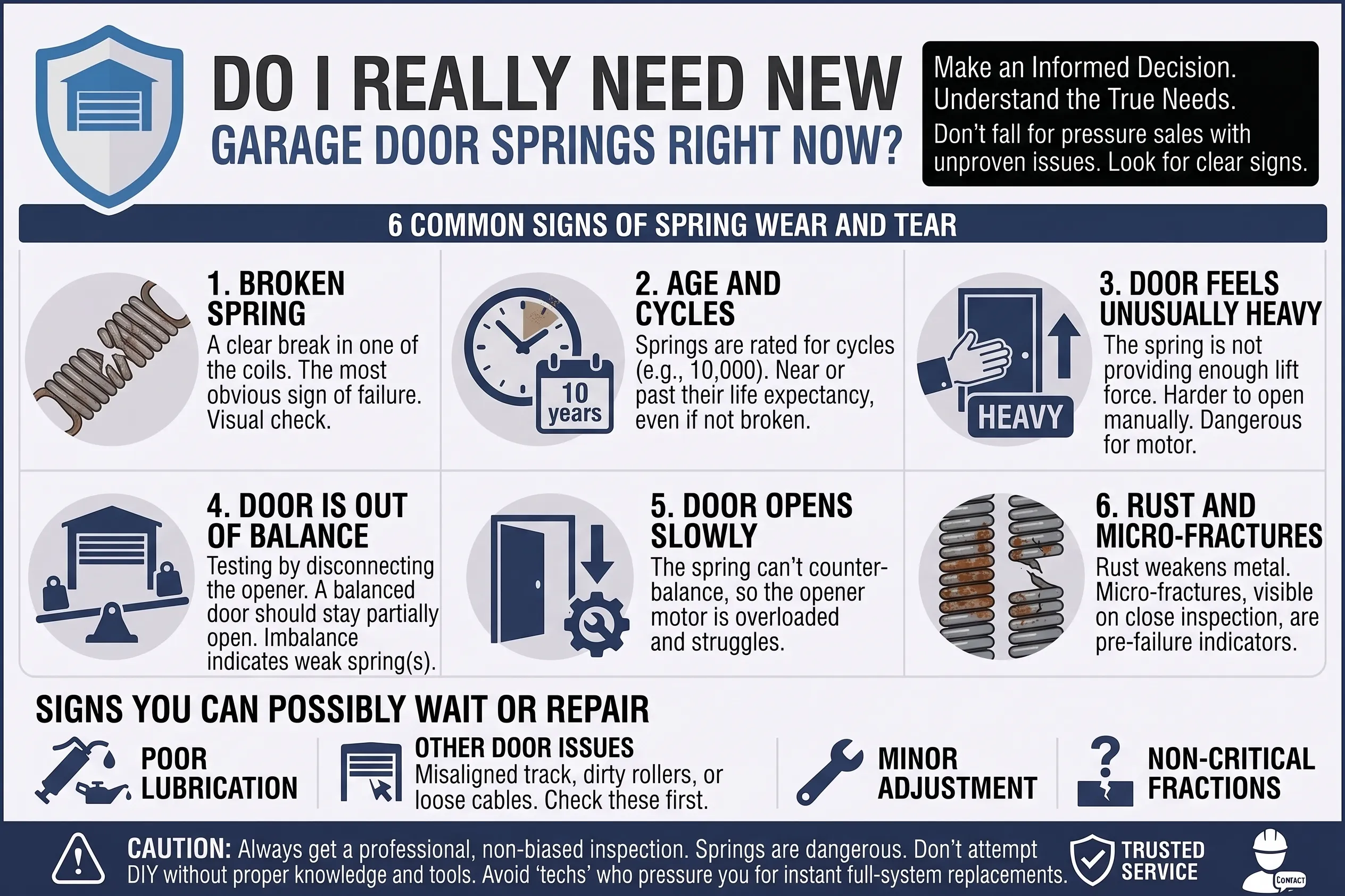
You likely don’t need immediate spring replacement if the technician can’t show you a specific, visible defect (a stretched, rusted, or broken spring), if they push full replacement without discussing a cheaper repair option, or if the recommendation comes wrapped in urgency rather than a clear explanation. Springs do fail and do need replacing, but “your springs need to be replaced” is also one of the most common lines used to justify an unnecessary upsell. Knowing what a genuine defect actually looks like, and asking to see it directly, is the fastest way to tell the two apart, whether you’re in one of our areas we serve or elsewhere.

What to Check | Legitimate Recommendation | Unnecessary Upsell |
Defect shown | Specific, visible (stretched, rusted, broken) | Vague (“needs to go,” “won’t last”) |
Scope | Explains why one or both springs need replacing | Full replacement pushed with no explanation |
Urgency | Concrete reason given for timing | “Could snap any moment” with no detail |
Alternatives | Repair option discussed if applicable | Replacement presented as the only option |
Price | Itemized, matches the explanation | Large total, thin explanation |
A legitimate reason to replace a spring, visible stretching, rust, or a broken coil, can be shown to you. If the technician says the springs “need to go” without pointing to something concrete, that’s a sign the recommendation may not rest on an actual defect. A visual inspection should take only a minute or two, and a confident technician will usually welcome the chance to point out exactly what they’re seeing.
Ask the technician to point to the specific problem with the current spring and explain, in plain terms, why it can’t be repaired instead of replaced. If the answer is specific, a visible gap in the coil, rust that’s compromised the metal, you have something concrete to evaluate. If the answer stays general, that’s worth treating as incomplete rather than sufficient, especially when the recommended fix is also the most expensive one available.
If the technician also seemed reluctant to answer basic questions or brushed past your concerns, it’s worth checking whether they’re even a legitimate operation in the first place; read Is That Garage Door Repair Company Actually Licensed? 4 Ways to Verify Before They Touch Your Door to see what to check before you authorize any work.
Sometimes only one spring, cable, or component has failed, but the recommendation jumps straight to replacing the entire spring system, both springs, cables, and drums, without explaining why the undamaged side needs replacing too. Replacing in pairs is sometimes a legitimate, standard practice for balance and even wear, but that’s different from simply assuming the customer won’t ask why.
If this scope-inflation tactic sounds familiar from a pricing angle too, read Why Is My Emergency Garage Door Repair Quote So Much Higher Once They Arrive? 5 Bait-and-Switch Pricing Tricks for the full pattern.
Ask specifically why both sides need replacement if only one has visibly failed; a common industry practice is replacing springs in pairs for balance, but that reasoning should be explained, not assumed. A technician who walks you through the logic, rather than simply stating the conclusion, is giving you something you can actually evaluate and compare against a second opinion if you still have doubts.
“This could snap at any moment” is sometimes true, and sometimes a pressure tactic used to skip past your questions. The difference is whether the technician can explain what they’re seeing that makes it urgent, versus simply asserting urgency as a way to move the conversation along faster than you’d otherwise allow.
The International Door Association flagged manufactured urgency on LinkedIn as a recurring industry-wide tactic.
Ask what specifically makes it urgent right now versus something that could wait for a second opinion, and pay attention to whether the answer is concrete or vague. A genuinely urgent safety issue, a visibly frayed cable under tension, or a spring that’s already partially separated is something a technician can describe in specific, verifiable terms rather than general alarm.
Depending on the specific issue, some spring or cable problems can be repaired rather than fully replaced. If replacement is presented as the only option with no mention of a repair alternative, it’s worth asking directly, since the omission itself can be a sign that replacement was decided on before the diagnosis, rather than because of it.
Ask plainly: “Is there a repair option, or does this specifically require full replacement, and why?” A legitimate technician can answer this without hesitation, and will typically be able to explain the tradeoffs between a repair and a full replacement in terms of both upfront cost and how long each option is likely to last before needing attention again.
When the dollar amount is large but the explanation is thin (“it just needs to be replaced”), that mismatch is itself worth noticing. A legitimate recommendation usually comes with a clear, specific reason that roughly matches the size of the job, and a technician who’s confident in the diagnosis generally has no trouble explaining why the price reflects the actual work involved.
Ask for the price broken down by part and labor, and compare it against a second quote if the explanation doesn’t clearly justify the total. A breakdown that separates the spring itself, labor, and any additional parts gives you something specific to compare across companies, rather than just one lump number that’s hard to evaluate on its own.
If this pricing pattern sounds like part of a larger playbook, it is. Read How Does the Emergency Garage Door Repair Scam Work to see how it fits alongside the other tactics scam operators use.

Springs are one of the most dangerous parts of a garage door for a homeowner to inspect closely, which is exactly why some operators lean on urgency and vague language instead of a clear, specific explanation. Asking to see the actual defect and asking whether a repair is possible closes most of the gap. It doesn’t require you to become an expert in torsion springs; it just requires asking the technician to show their work and explain it in terms you can actually evaluate.
If your door needs more than a repair, or you’re ready to stop patching an aging system altogether, Flush Mount Door Co. can walk you through what an honest replacement recommendation actually looks like. Contact us or give us a call to talk through your options.